
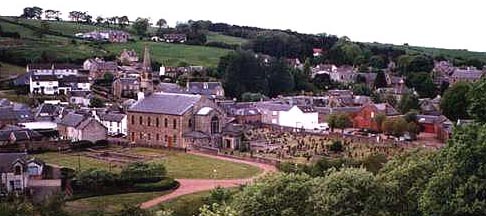
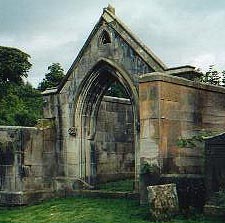
 This shows the rear and cemetery yard of the church, with the remains of Abbeygreen priory from 1104 A.D. on the lawn. The town's main street isn't visible, but runs across the centre of the photograph, in front of the church. |
|
|
|
 |
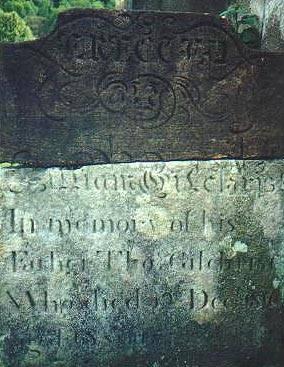 |
"Erected by |
|
Son who died 22nd January 1841 aged 5 and James his son who died 3rd May 1844 aged 11 months Isabella Sharp his wife Died 21st April 1860 Aged 55 Years. William Gilchrist died 18th October 1866 Aged 69 years" |
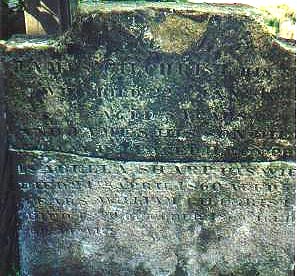 |
There was, however, no Thomas Gilchrist in the burial registry for the cemetery. There was, however, a Thomas Gilkerson, and there is what we might call "a fair chance" that this was the same person. I say that because Thomas Gilkerson died the same month, although his age is shown as 67 rather than 68 - but there is no Thomas Gilchrist listed in the burial register and no Thomas Gilkerson on any of the cemetery monuments even though he was recorded as being buried there, so it seems plausible that both names refer to the same person. This "cemetery anomaly" might be best explained by a change in custom in the region as to how the name should be spelled:
Name spellings were quite fluid in those days, depending on which clerk was recording them: William's name was also recorded as Gilkrest in the 1841 census - this was during a transitional phase from the "Scots" dialect spelling which originated in the early Norse influence to the English form (ie. k to ch) which has been considered more "proper", more "educated" and "upper-crust" in Scotland for the past two hundred years. This may explain why there were so many Gilkersons but no Gilchrists in the region until William's banns of marriage were recorded. Interestingly, Jimmy Hamilton transcribed interviews of his Lesmahagow neighbours in the dialect he terms "the Doric" right into the late 20th century - oral custom being more tenacious than rules of spelling. (By "Doric" he meant more rustic, more rural - originally a Greek term, the opposite of "Attic", which meant sophisticated and urbane, and of the city folk who lived in Athens.) There is further support for
this assumption about a name change in the family tree from a
descendant of Thomas Gilkerson through his son James Gilkerson
to his son John Gilchrist and his son James Gilchrist - the same
kind of sudden name shift. In this way the Gilchrist name in
that region became altered within the first quarter of the
nineteenth century. The 1783 Parish census shows a list of
Gilkersons and no Gilchrists; but the 1821 Lesmahagow census
(which was supposed to be destroyed, but a record survived)
shows only Gilchrists except for three Gilchristsons, and two
Gilchrisons, which could simply be a spelling in transition from
Gilkerson - it may have seemed a more precise pronunciation and
spelling. Some writers have called names with "son" at the
end "Anglicized", to distinguish them from those with the more
Gaelic "Mac" at the front, as in MacGilchrist (yes, there were
also some of those, from the west coast). However, it was
also a very Norse construction, sometimes spelled and pronounced
"soun", and as a study of the region shows, there was a lot of
early Norse influence in placenames, as well as family
names. (There were also Norman, French and Flemish names
resulting from various land grants.)
[Important: If you are a descendant of
William Gilchrist and Isabella Sharp (or Sharpe), do not take any of the
following paragraph as factual information for your ancestry
tree! It is merely here in case it can be linked to some future
documentation discovery, and it is probably irrelevant to our
tree:
There was a James Gilkerson who lived in
Auchenbeg from the 1680's to the 1760's.
I'm
told that his son John Gilkerson was born circa 1714, worked as
a weaver and married Katharine Millar, daughter of James and
Anna Millar - however, I haven't got the registry sources for
any of these details at the moment, and I'm suspicious because
the names and dates below match the John Gilchristson and
Cathrine Millar I mentioned above, and I actually have seen the
registry entry for them upon Thomas' birth. The other
details: they were married on November 27th, 1736 at Auchenbeg,
in the Parish of Lesmahagow. They had perhaps as many as
seven children, and we know the names of five of them:
Anna (b. 1737), James (b. 1739), John (b. 1742), Thomas (b.
1749) and William (b. 1751). There may have been a child
between Thomas and William, and another after William. The Thomas from this
family would have been age 67 at death, not 68 as the tombstone
states, which makes it possible that this is the Thomas
Gilkerson in the Lesmahagow Cemetery burial registry; but
perhaps our Thomas Gilchrist was really an altogether different
individual who simply doesn't appear in surviving parochial
records, and wasn't entered into the burial registry for some
reason. The naming patterns are
similar in that we do have a James, a John, a Thomas and a
William, but we also have a Robert, (and of course a Janet and a
Margaret, named after their maternal and paternal
grandmothers). The name "Anna" appears nowhere downstream
on our family tree, and William named no daughters Katharine, or
Millar. So this could be our Thomas's father, but it
probably isn't...and there's no way to be sure, no way to know
one way or the other, at this point. One is tempted to simply
say, "Oh for Pete's sake, they just changed their names a lot
depending on who was doing the recording, and there weren't
any others at that place and time", but that becomes
conjecture, and the other elements don't square up,
either. And in fact, there were a surprising number of
Gilchrists, Gilkersons and Gilchristsons with only about a
dozen common Christian names, in that and nearby parishes.]
What we do
know:
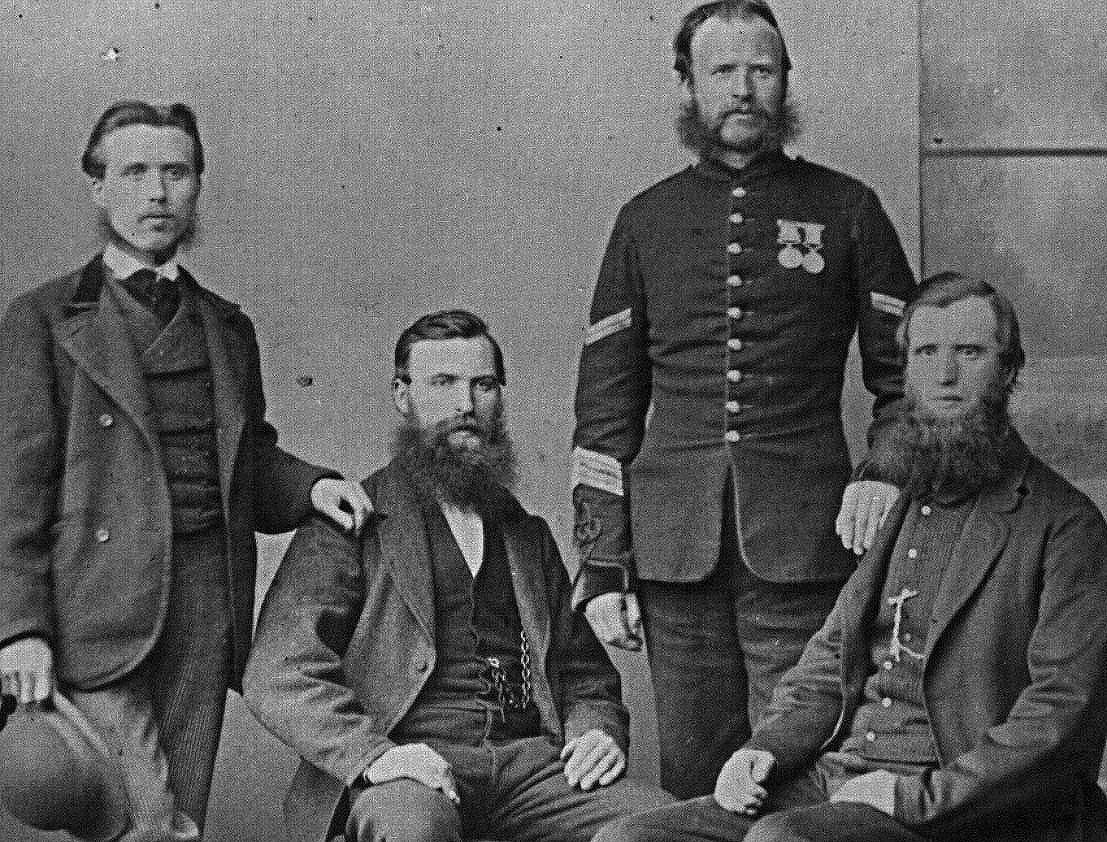
Left to right: Robert (we used to think
this was James, but James died at age 5 according to the
tombstone), John, Thomas and William - according to my father's
notes on the photo. I don't have a photograph which includes
their parents or the sisters. I now believe that this
photo was taken of the brothers when they all returned home to
bury their father, in 1866. Thomas is wearing his full corporal
stripes, which he earned in 1864, as well as his Crimea Medal
and Clasp for Sebastopol, and his Turkish Medal. We have a
small diary from Thomas which covers those years. It is
sad that female children were not, one assumes, considered
important enough in those days to be included in such a
significant photograph on such a momentous occasion...it would
have been "unseemly", perhaps - but I would have loved to see
what my female ancestral relatives looked like.
Thomas' siblings were: Janet
(b. 2O/lO/1825 in Dalserf), Margaret (b. 5/2/1828 in Hazlebank),
John (b. 7/6/1832 in Auchenheath), William (b. 1836 in
Lesmahagow), James (supposedly b. 1838 in Lesmahagow; however,
the gravestone says he died age 5 in 1841, so he might have been
a twin to William), Isabella (b. 1840 in Lesmahagow), James (b.
1843; lived 11 months), and Robert (b. 1846 in Lesmahagow).
There may have been a final child named Marion as well - I
remember seeing her listed just over on the next page of the old
parish registry in Lesmahagow, but for some reason I don't have
any other information about her at the moment.
[A note regarding the two
James': apparently it was quite common in those days to name a
new child after a previous one who had died. This may have
had something to do with the fact that children were named in
honour of parents and grandparents, so if they died, the honour
had to be "re-bestowed", as it were, in the naming of a future
child.]
The eldest daughter Janet
married William Fraser, who was the informant listed on
William's death record; her younger brother William Gilchrist
was recorded living in her house on the 1851 census - he was 16,
and perhaps couldn't live with his parents at that age.
Some of Janet's descendants now live in Australia, which I
learned when contacted by one of them, Jeanette Byfield.
She also has descendants here in Canada - Sheila Massi and Linda
Hunter. I have a Fraser tree and descendancy chart in my
father's binder collection, and a letter and some photos from
Jeanette. Some of that family emigrated to New Zealand, as
well.
Janet is known as Janet Hill Gilchrist by her
descendants; Hill was her grandmother Janet Sharp's maiden
surname. It was at this time that middle names were
becoming popular in Scotland, but I don't know of middle names
for any of her younger siblings. Her nieces and nephews,
particularly Thomas' and Robert's children, seem to have been
given middle names, also. For example, her nephew Robert
also got his grandmother's maiden name, Sharp, as a middle name,
but his first cousin, my great-grandfather, was William Thomas
Gilchrist, so middle names began to follow more relaxed rules in
that generation - his middle name was not a grandmother's maiden
name, but the Christian name of his father and
great-grandfather.
The following fascinating record, supplied by my Scottish friend from the Archive Office in Glasgow, suggests that William and Isabella weren't that well off in their golden years, although you'd expect they may have had some unofficial support from various of the children whether at home or away:
Lanarkshire Poor Law Records - Year 1856 - CO1/47/32 - Entry No. 9 Robert moved to Renfrew, near Glasgow. I'm
guessing that he'd somehow parlayed the weaving background of
the family (through my Dad, I've inherited a piece of weaving
from my great-uncle Alex that he made in convalescence after his
WWI head injury) into a tailoring apprenticeship, eventually
owning his own business. He married an Irish lass named
Lettia, aka Laticia (sometimes Letitia) Drennan:
They had a clothier
business on 102 High Street, (at Craigsend, Inchinnan, I
believe, basically a suburb of Renfrew) employing "3 Men, 3 Boys
and 4 Girls", according to the 1881 census. The census
puts him at age 35, and as having come from Lesmahagow, Lanark.
His Australian descendant Jenny Page wrote about as many as nine
(now ten, actually) children whom they named "Jane
Drennan b 5 June 1874, Isabella Sharp b 20th August, 1875,
William Carson b abt 1877 - d 6 Feb 1917, Robert Sharp b 1879 d
1880, Annie Morrison b & d 1880, James Drennan b abt 1878
& John Drennan Carson b Jan 1884 - my great grandfather.
Annie Morison, was born in Emu Flat on 27 Sept 1887, near Clare
in South Australia but died a month later and Letitia died a
month after that." Later she added, "There
were also two other daughters that I discovered after my first
posting - Jessie b, abt 1883 and Maggie b. abt 1886." Maggie
would seem to have been born on the ship, during passage to
Australia.
It had become customary
to give your children middle names around that time, and
surnames of past in-laws were considered appropriate, which
helps even further with tracing lineage. Jenny Page says
elsewhere that Annie Morrison died in 1881; however, she also
writes (see below) that the Annie born in 1887 was Annie
Drennan, who was born and died in infancy in 1887 at Emu Flats,
near Clare, Australia, shortly after the family arrived
there. Now, Jenny also says in another posting that
Letitia herself died within a month of her arrival in Australia,
so perhaps mother and daughter both perished in or as a result
of complications at childbirth, or within a month of each other;
however, the name inconsistencies in Jenny's accounts, including
a tree she has posted on RootsWeb with incorrect names (and
repeated by various cousins, it would seem), leave me wondering
how much of her tree is based on shifting oral accounts from
various sources, how much from inaccuracies already published in
a badly flawed tree on RootsWeb in 2005, and how much from
speculation, rather than census data or other documentary
sources. Mind you, she might also have made a few simple errors
and not spotted them in her own proofing until much later, if at
all - I've certainly come across similar errors of my own, over
the years. Later I learned of yet another daughter, Janet
Fraser Gilchrist, this time documented elsewhere, who was born
in 1892 - see below.
Anyway, sometime around 1887,
it seems, Robert moved his family to sunny Australia, arriving in
Victoria on the Loch Sloy, in Sept 1887, "port B". His son William Carson Gilchrist enlisted in the
Australian Army at the age of "39 2/12ths" on June 13th, 1916,
and his entry into Australia was recorded as being at age
10. He had been a "tailor's traveller" by occupation, a
salesman for the family business, Clare Clothiers - Clare being a small town in South Australia, not
far from Adelaide. He was a small man, 5' 2 1/4", 150 lbs; he was sent to
cold, damp England for training in October, but that must have
been his undoing, because he died of bronchitis the following
year, after surviving only one winter. He left everything
in his will to his younger brother James Drennan Gilchrist of
"Clare Clothier", who was the executor of his will, and his
youngest brother John. His sister Isabella Sharp Gilchrist
was recorded on his enlistment form as living in Napier, a town
in New Zealand. I got the following leads and links for
this information from his great-great-granddaughter Leanne
Tysoe, who lives in Perth, Australia - William married Lucy
Carter, Leanne's great-grandmother.
http://www.aif.adfa.edu.au:8080/showPerson?key=GILCHRIST/WC/6462
and
http://mappingouranzacs.naa.gov.au/Details.aspx?barcode_no=5100103&TB_iframe=true&height=500&width=600
Jenny
Page, née Gilchrist, wrote a connecting bit of
info on Rootsweb in 2007:
"Hi! My name is
Jenny Page. My grandfather was John Drennan Carson Gilchrist.
He emigrated to Australia from Renfrew, Scotland with his
father, Robert Gilchrist (clothier & tailor), his mother
Leticia (formerly Drennan) and brothers William Carson and
James. They moved some time after John's birth in Renfrew in
Jan 1884 and the birth (& death) of Annie Drennan
Gilchrist in Sept 1887 at Emu Flat (near Clare) South
Australia. I know that John's sister Annie Morrisom Gilchrist
died in 1881 but do not know the fate of his other sister,
Isabella Sharp (b. 1875) and there is no sign of her in
Australia. ALL of the Gilchrist trees I have found have left
my grandfather out. I'm just letting the Gilchrist community
know that this family branch continues."
Jenny Page lived in
Adelaide in 2007; I wish I’d remembered and tried to find her
when I was there in March of 2011. She referred at one
point to her great-grandfather as Robert Sharp Gilchrist, but
this the first time I’d seen any notion of Robert
using his mother’s maiden name as his middle name; according to
the records I have, Robert and Letitia named their son,
b. 1879, Robert Sharp Gilchrist, which makes a lot
more sense in terms of Scottish naming patterns and the dates at
which middle names began to be used by our ancestors.
Robert Sharp Gilchrist died at the age of 17 months, however, in
1880. I've tried to contact Jenny by email, without
success; I wish I could, because now I have answers for her
questions about Isabella, and news of a younger sister of her
grandfather that she may never have known about.
| Service Numbers: | SX7266 |
|---|---|
| Enlisted: | 29 June 1940, Wayville, SA |
| Last Rank: | Lieutenant |
| Born: | Balaklava, 27 August 1918 |
| Home Town: | Balaklava, Wakefield, South Australia |
| Memorials: | |
| 29 Jun 1940: | Lieutenant |
|---|
Janet Hill
Gilchrist Fraser had as many as ten children with William
Fraser, including a son Richard Fraser who also went to
Australia. Richard had a sister Janet Watson Fraser, according
to Linda Hunter; descendant and tree-builder Steven Fraser
thought she could have been named Janet Gilchrist Fraser, but
Watson makes more sense if that was William's mother's maiden
name (i.e. Janet's maternal grandmother). She would have
been 35 and apparently unmarried at the time, and Richard would
have been 25. He married Mary McIntyre MacArthur, and they
had seven children, including a daughter who was definitely
named Janet Gilchrist Fraser, and is also recorded by one list
of online Frasers as having died, unmarried, in Napier, N. Z.
possibly in the "1927 earthquake" in Napier - which actually
happened in 1931, however. She also writes (sic), "Another
bit of family lore that I recall, however, there were aunts who
went to New Zealand and were lost in the earthquake. We
know now that only Janet went to N.Z. but perhaps she went with
Gilchrist cousins and the Gilchrist family in Australia as well
as the Fraser family, still in Scotland, lost touch with these
young women." This might explain the lost contact with
some or all of the three girls I've mentioned in the previous
paragraphs. We do know what happened to Janet Gilchrist
Fraser, however, as you'll see just a few more paragraphs on.
Linda Hunter tells us that "Janet Watson
Fraser married twice, her last husband being a Muir and they had
a daughter Janet." This would seem to connect
with Isabel Gilchrist's lineage, further up this page - she
explains that she is the daughter of "Janet Gilchrist Muir", b.
1888.
"Janet Watson Fraser's first child appears to
have been born out of wedlock - he was named William Fraser and
was raised in the home of William and Janet Fraser" (i.e. his
grandparents).
"Richard's daughter was Janet Gilchrist
Fraser and it was this person who went to New Zealand. We
don't know what year she went to New Zealand but as my
grandmother" (Sarah) "- the eldest child of Richard and Mary -
arrived in Canada in 1910, it is conceivable that her sister
Janet, who was closest in age, also left home at the same time -
only to go to New Zealand. In my family line of Frasers,
emigration to Australia began in 1921 with Kate, followed in
1925 with Maggie and a year later William (father of Jeanette
Byfield who, by the way, passed away a few years ago). In
1928 Richard and Mary joined their children in Australia."
Linda continues: "
It was part of the deal when my
Grandmother Maggie (their daughter) married John McPhail that
her parents could come to Australia and live with her.
(Richard and Mary are buried in Neerim Cemetery in Gippsland,
Vic)".
Linda
Hunter got new information from Merryn Cadle, that Janet
Gilchrist Fraser resurfaced after the earthquake: New Zealand Electoral Roles -
Otaki General Role, Wellington - Levin Farm, Kimberly
Rd. (Levin Farm was a Mental Deficiency Colony and
renamed as Kimberly Centre open from 1945 - 2005). She
was listed as a spinster.
1946 - Role # 3856
1949 - Role # 4994
1954 - Role # 4763
1963 District of Porirua, Region of Wellington, Porirua
Hospital (Mental Hospital) - Cook - Role #42
In going through the Electoral rolls,
Linda states, as indicated above: "The earliest I've come across
Janet Fraser that could be our Janet is 1938, a spinster, living
at 10 Man St. (Main?) Palmerston North. From 1946 she is shown
living at Levin Farm (a mental institution) until 1957 when she
is living at 8 Roberts Rd., Wairarapa, Cook; then in 1963, at
Porirus Hospital as a Cook."
Merryn Cadle confirms: "Janet Gilchrist
Fraser died 27.12.1965 in NZ, daughter of Richard Snr (I have
the death certificate) Buried Old Levin Cemetery, Levin (bottom
of North Island) General Row 24 Plot 55. Her sister, my
grandmother, assumed she died in the 1931 Napier earthquake or
the following tsunami - however she worked for decades as a cook
in the 1930s to 60s in lunatic asylums/homes. Ex inmate??? No
one knows."
In September 2014 Merryn and her husband Mark provided a lovely blue marker for Janet Gilchrist Fraser, and described their research and a strip of photos of their trip to her gravesite in Levin, where Janet worked as a Scottish spinster lady in the Kimberley Centre canteen as a cook, rather than Merryn's initial speculation that she might have been an ex-inmate, although who knows under what conditions she arrived there in the first place. This discussion and the photos can all be enjoyed on our Facebook group, mentioned at the head of this page. There's quite a bit of useful material accumulating there - no point duplicating it all on this page.
I'd be very curious to know why Robert's
daughters and Richard Fraser's daughter were both drawn to
Napier, Hawkes Bay, New Zealand. Who did they know
there? Did Richard Fraser actually end up there himself?
Who was the "Rev. R. M. Fraser" who accompanied Robert's
daughters back to visit their father and brothers in Clare, near
Adelaide? I hope other descendants of Robert
or of his sister Janet Hill Gilchrist Fraser might
someday read this and provide further insight.
John married Margaret Watson (pp. 30-31 of the
Lanark SRI) from Lanark. William Gilchrist and Isabella Sharp
are listed as his parents on the marriage entry, so we can be
sure of this:
They moved to the east end of Glasgow, to
Barony, according to the 1881 British Census. He lived at 74
Barrowfield Street (which is now torn down) and worked as a
"Vanman", transporting goods by horse and cart in the days
before motorized trucks were invented. His children were
named William (a manufacturer's clerk), John (a joiner), Robert
(a dyer's clerk), James (a "scholar" still at age 13) and
Margaret, who was 11 years old in 1881. Click here for a page of records that
give more information about John's and Robert's families.
When I was in Glasgow I saw a
huge wrought iron gateway with the name "The Barras" close by
Barrowfield. Later I learned that it was - and still is,
to an extent - "our version of the Paris flea market, a rich
tapestry of Glasgow life which rose from the poverty of the
slums which once surrounded it" (ref).
The
site
was
acquired
and
developed
for
vending
by
Maggie
McIver
in
the
1920's,
but
it
has
its
roots
in
the Victorian era when goods were sold from barrows there.
John would have delivered goods for the barrow vendors with his
horsedrawn van, in a very vibrant, colourful place to live and
work.
(An interesting bit of local
colour: "part of the site had been the estate of the late Marion Gilchrist,
about whom litigation had been fomenting for over 20 years",
making it difficult to procur the site. "Miss Gilchrist is a
part of Glasgow's history too, as the woman for whose murder
Oscar Slater, wrongly and disgracefully, was to serve 18 years
in prison." This was an incredibly famous case that
reverberates in Scotland to this day, and led to the formation
of the Scottish Court of Appeal. Just do a search on
Marion and Oscar and see what comes up. She was no
relation to us, however.)
In the 1891 census, John was
recorded as living at 78 Barrowfield in "Camlachie" instead of
Barony, but it is the same place. Camlachie is the name
for the parliamentary district, while Barony is the "civil
parish". John is aged 58 on this census. His wife is no
longer listed, nor his son John. Margaret was noted as
deceased on her son John's marriage certificate of 1889 to
Elizabeth Kinnaird, and presumably they'd moved out to a house
of their own by 1891. John senior's employment is now
"warehouseman". He has three unmarried sons still living
in the same house: William, a "ShopKeeper(Spirits)", aged 34,
Robert, aged 26 and James, aged 24. Both the younger men
are listed as "Clerk".
James got married in 1893 to
Margaret Douglas Buchanan, and according to my Scottish source,
they moved to Girvan, Ayrshire, where they ran James Gilchrist's
Wine and Spirits Shop on Dalrymple Street. A few years
later they moved 25 miles north to the town of Ayr where they
opened the same business. James died about 1929 and his wife
continued to run the business until her death in 1935. Their son
James then took over the business and was noted in the records
as being a Publican. The business seems to have passed out of
the family by late 50's or early 60's. The pub still
stands, but by the turn of this century the its name had been
changed to 'Wee Windaes', which refers to the bulls eye window
glass.
James and Margaret had a son John Buchanan
Gilchrist who married Francis Vickers Thomson in 1923; they in
turn, I believe, had a son James and a daughter Agnes S. - a
note in square brackets after her name says "[Mrs G. Shepherd,
Preston, England]" - not sure that that means, but I assume it
is her husband's name. James and Margaret also had a
daughter, Margaret Buchanan Gilchrist, who married Andrew
Farquhar, and they had a son, Douglas Andrew Farquhar. His
family live in Tasmania, and I corresponded with Kate Farquhar
in March of 2011 while I was in Australia, but didn't make it
over to Tasmania to meet her - I'm hoping to make another trip
and meet a number of Gilchrist descendants, perhaps in 2013.
My source mentioned a second daughter, Joan
Watson Gilchrist; only described as "deceased", however.
John's daughter Margaret, listed as aged 22
on the 1881 census, must have been a housekeeper for the four
men; no other occupation is listed. In 1895 she married
John McDermont, a "provision merchant", who was 28 year
old. They are the only remaining family so far found in
the 1891 census six years later; John is a "shopkeeper, grocer"
then, and an "employer", and he and Margaret have a son named
John who is 4 years old. Her father and brothers don't
seem to appear in the 1901 census, but no doubt they and their
children still lived and worked in Glasgow, and their
descendants should be traceable with enough time and diligence.
We do have a Death Certificate
for John senior:
The family had apparently moved by the 1901 census, I don't know where; but no doubt the children still lived and worked in Glasgow, and their descendants should be traceable with enough time and diligence. This is an entry for his son John at an address which is just around the corner from Barrowfield Street:
1901 GLASGOW CENSUS Reg. No. 644/2 Enum. Dist. 50 Page 15His little son William's birth is noted also:
YEAR 1897 BIRTH CERTIFICATE Reg.No.644/2 Entry No.926John's younger brother William was a miner in 1856, and joined the Lesmahagow 37th Lanarkshire Rifle Volunteer Company towards the end of 1859, when the country was threatened with invasion from France; as did James Gilchrist of nearby Kirkmuirhill, ancestor of J. (John) Brian Gilchrist, currently one of Canada's foremost professional genealogists. Nor do I know what became of Margaret and Marion, although Isabella was listed as "housekeeper", age 21, taking care of her 63 year old father in 1861, after her mother died. Marion would only have been 12 by then, so if she was left off the census, it is possible that she had died. William's son William was living at home again then also, at age 26, and so was a granddaughter named Isabella, aged one year. Here are the younger Isabella's birth certificate details:
BIRTH CERTIFICATE Reg.649 Entry No.108 Lesmahagow I can't find the younger
William living in Lesmahagow in 1881,1891 or 1901, so he must
have moved on by then, perhaps to Glasgow, or to a military
career building on his experience with the Lanarkshire Volunteer
Rifle Company. Great-aunt Burnice told me that one of my
great-grandfather William's uncles ended up in Boston, and
worked as a merchant, with a Jewish partner. All I have
been able to uncover from this lead is that there was a very
famous Gilchrist's Department Store in Boston, founded by a
Robert Gilchrist (there are several internet references to
it), but I believe that it was founded in 1824, which is
about fifty years too early to have been our Robert; and we know
that our Robert went to Australia. She also told me that one
brother - perhaps the same one - visited Thomas in Poplar Hill
after he settled there in 1872, but she didn't know where he
went on to from there. This is still apocryphal information,
sadly; we have no old letters or records to verify it.
Burnice also told me that this brother or another one had ended
up in Australia. It is true that William (born Lesmahagow 1887,
died Australia 1945; grandson of Janet Hill Gilchrist Fraser)
and his wife Jean nee Gibson and 9 children emigrated to
Australia in 1926, and now I know that his uncle Robert
Gilchrist preceded them, arriving in Australia in 1887, the year
William was born. William's grandmother Janet Hill
Gilchrist Fraser died in Lesmahagow in 1899.
My Scottish friend pointed out that the uncle Burnice
referred could as easily have had the surname Sharp, rather than
Gilchrist. Another tenuous connection we might expand on
later is John Sharp's "grand niece" whose name is listed on the
1871 census of his household as Isabella Robertson, but she was
only 11 years old then so she probably had a married surname
that I don't know. A future project for me is
to build a large mobile hanging from the ceiling, on which I can
connect each individual in this tree listed on luggage tags, so
that I can "see the big picture", as it were, a little
better. The main branches remain clear in my mind, but
some of the spreading branches are difficult to recall and I'm
always afraid that I'll hear from someone that I ought to
connect to my tree but won't remember where or to whom.
This is what is known so far of
my family which lived in Scotland in the 19th century. With a
little more digging, we'll discover more - including more living
descendants of Robert, and some of John, I'm quite sure.
Wouldn't it be great if someone in those family lines had saved
some photos and records?
(Click here if you wish to skip directly to the next page, about Thomas)
Lesmahagow is a town southeast of Glasgow, Scotland in the County of Lanark. The prefix "Les" may be a derivative of Ecclesias, or "church"; "mahagow" is a corruption of St. Machutes, a disciple and companion of the legendary St. Brendan who made an adventurous voyage to the Orkney islands in the mid-6th century. The town is in the district of Strathclyde, the "valley of the Clyde" river (or, the "warm valley"). In pre-parochial days, it was a magnificent agricultural area of oaks and orchards said to have been planted by monks from the Abbey of Kelso who were sent to establish a monastery and abbey in Lesmahagow. The area retains a great deal of that beauty today, although sheep and cattle farms have taken hold as well. The earliest history is to be found in the Book of Kelso, and the 1864 historical account is fascinating to read.
There is evidence that a Culdean (early Celtic)
monastery existed at Lesmahagow since the days of St. Machutes
back in the 6th century. Monks appear to have fanned outward
from the Solway, and monasteries and abbeys arose at Sweetheart
Abbey and New Abbey near Dumphries, farther north in Melrose,
and many other locations, including the largest and most famous,
the Abbey at Kelso. It is likely that my ancestors were employed
by these abbeys, which were tremendously wealthy and supported
huge local economies; we have a name that might have signified
membership in a particular chapter of an order, similar to
Gilpatrick, Gillespie, Gilmagu, and so on. The monks lived
in relative comfort and security, and the Prior lived like a
prince, probably in a fine home located at a place still named
Priorhill. At Kelso, at one time, the monks "owned 6600
sheep, besides large herds of cows and swine, oxen for their
numerous plows, a stud of brood mares, mills to which their
vassals were "thirled", brewing houses, mansions in burghs, and
fishing". The Lord Abbot "had a retinue of servants; and
kept horses, hawks, and hounds, and had pleasure boats, gardens,
lawns and orchards. His attire on ceremonial occasions was
gorgeous". Not quite what we mean today when we refer to
"the monastic life"...and it all ultimately led to the
Reformation, of course.
In earlier days, the Britons defended Strathclyde against the more northern Picts, the "Irish Scots" of Dalriada (modern Kintyre), the Saxons of Northumberland, and the Cruithne of Ulster. The Saxons formed a union with the Picts at the end of the 8th century, and in the middle of the 9th, Kenneth mac Alpine united the Picts and Scots. The Britons were gradually overwhelmed, and the Kingdom of Strathclyde broke up by the end of the century; many of the petty chiefs apparently emigrated with their tribes to Wales, to a kindred race of people with a similar language. If there were any Giolla Chriosts in this movement of people, their descendants may eventually have returned as the Gilchrist Bretnach (= "Briton-man", or Welshman) mentioned on an earlier page of my website, on the History of the Name. A man of this name witnessed a land charter in Carric in 1200 A.D., according to the abbey register of Melrose. (Perhaps he was a hold-over, a Briton who stayed behind when the others were pushed out; but it seems unlikely that his neighbors would continue to recognise his racial identity three centuries after the disappearance of his people, so I suspect he was a returnee connected with the maintenance of the abbey.)
The lowlands were re-populated with "divers tribes of divers nations from divers parts": Anglo-Saxons, Picts, "Scoto-Irish", and a great wave of "gall-gaidhil" from Galloway. In the 12th century, land grants were awarded to Flemish noble families, which resulted in the people of Lesmahagow being governed by the Hamiltons.
In 1144 A.D. King David I granted the church, in the central village of Abbeygreen, and all the lands of Lesmahagu to the Abbey of Kelso, and a monastery of Tyronensian monks (from the Diocese of Chartres in France) was established - one of six in Scotland - under the approval of the Bishop of Glasgow. They had already built the church, within the first two decades of the century, so the grant was rather a formality. A lot of local men gave away large chunks of their lands to this monastery in return for "fraternity" and a sort of afterlife insurance.
We know that there was a Gilchrist family named after a landform, Gilkerscleugh (= "Gilchrist's cleugh"), who intermarried with the Hamilton family when they arrived. We also know that Gilchrist Kidd (also spelled Gilcriste Kide in another source) had lands along the Nethan river, c. 1180 A.D. and for some time after, according to the Register of Kelso.
No other Gilchrists appear for a period of years, however, in this immediate neighborhood. In the parish register of 1624, and the poll tax register of 1695, there are many Gilkersons, Gilkesons and Gilkerstons - sometimes within the same family - but no Gilchrists, per se. And in fact, very few other "Gil" names, which had once been so common in this region. Interestingly enough, there was a Gilmagu who owned land near Gilchrist Kidd; his name evolved from Gille Mahagu, or "servant of St. Machute", the patron saint of the church of Lesmahagow.
In the 1695 poll tax record we meet:
In 1755, there were only 2996 people (532 families) in the entire parish (the population of a large high school today!), 62 of whom were weavers and 40 of whom were masons. In 1801 there were 3070 inhabitants according to Government census, 2019 of whom were employed in agriculture.
Quite suddenly, the modern spelling of Gilchrist appears in the parish, in the form of a proclamation of the Banns of marriage of my great-great-great-grandparents William Gilchrist from Threepwood and Isabella Sharp (sometimes spelled Sharpe) in 1824. Were their families there all along, or had they come from somewhere else? On the 1841 census, they spelled William's name as Gilkrest (the only time it was misspelled). The only Sharpe on the 1695 tax register was James Sharpe of Lawwards (?). Isabella was from the parish of Dalserf, and was actually born way up in Rothesay on the Isle of Bute. Her parents and brothers lived in Hazlebank, but she settled in Crossford village with William. William was a quarrier, but Isabella's family were cotton handloom weavers, and her sons were apparently trained in that craft when they came along.
Not much later, Rev. J. Gilchrist appears as a candidate for the ministry of the church in Lesmahagow. He applied twice (both times unsuccessfully - he was on a list of eleven candidates) in 1838 and again in 1842.
The population of the parish doubled in the first 40 years of the century, which must have put a terrible strain on the resources and the employment of the region. There were great gas coal fields, and I suppose that it must have seemed to be an area of considerable industrial growth and opportunity to migrate to from the west coast. In the "Annals of the Parish of Lesmahagow", J. B. Greenshields writes,
"During the last three years" (c. 1850's)Sadly,
"an exceptional state of matters has existed, three
voluntary assessments having been raised to assist
the handloom weavers thrown out of employment by the
civil war in America. A large proportion of the amount
of these assessments was expended on the parish roads."
"The improvement on the Larnark road at HillsgillThis increase of population, coupled with the rather sudden appearance of the modern form of our surname, leads to another slim possibility that Thomas Gilchrist the senior (and the other Gilchrists; odds are they came as a family) moved to the parish from elsewhere - perhaps Ayr and/or Kilmarnock to the west, or Dumphries to the south - in the late 18th century. There were genuine "Gilchrists" of that spelling living in both areas as much as a century earlier. A third possible origin would be Rothesay on the Isle of Bute, since that is certainly where William's wife Isabel came from, and where Ronald Gilchrist moved to Islay from at about the same time.
was begun by the unemployed weavers, but the greater portion
of the cutting and embanking was finished through the agency
of a contractor, who did not employ them."
